Osinbajo Calls for National Debate on Cost of Governance in Nigeria
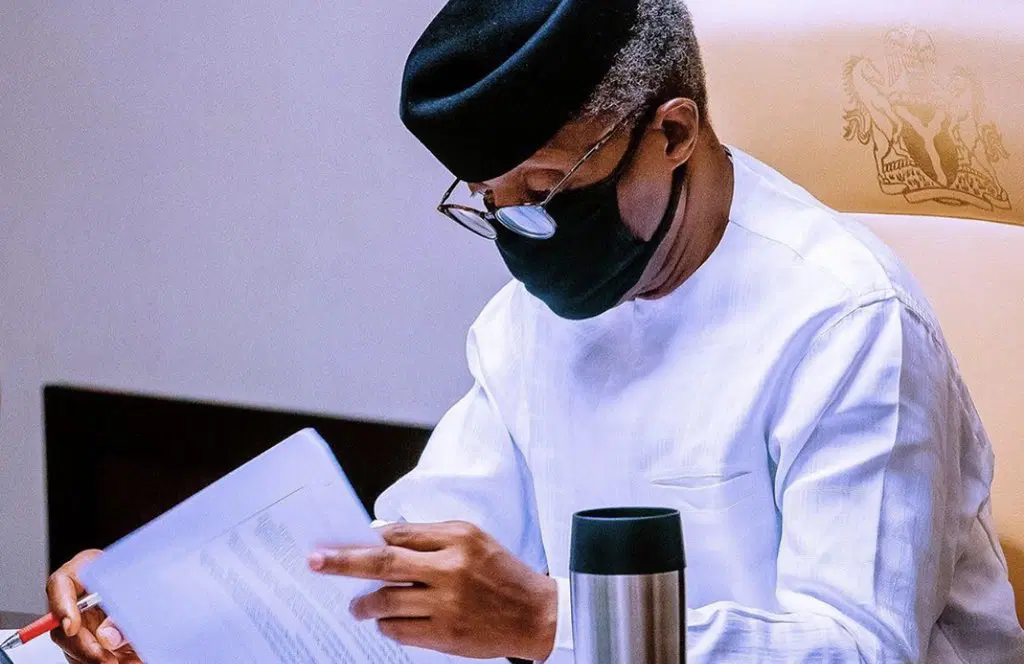
Vice-President Yemi Osinbajo has called for a national debate on the size and cost of governance in Nigeria, describing the existing structure as expensive and increasingly difficult to sustain.
Osinbajo said reducing the cost of government was necessary but acknowledged that achieving major reforms could be difficult because some changes would require constitutional amendments and the cooperation of lawmakers.
He spoke during a webinar organised by Emmanuel Chapel with the theme, “Economic Stability Beyond COVID-19,” while responding to questions from former Central Bank of Nigeria Governor and immediate past Emir of Kano, Muhammad Sanusi.
Sanusi had raised concerns about the cost of Nigeria’s governance structure, arguing that the country needed to consider significant reforms to make government financially sustainable.
He suggested that Nigeria should examine options such as reducing the cost of the legislature, making lawmakers part-time, considering a unicameral legislature and restructuring aspects of local government administration.
Sanusi argued that the country needed to align the size of government with the resources available to it and think creatively about reducing recurrent expenditure.
Responding, Osinbajo agreed that Nigeria was operating a large and expensive government but noted that some proposed reforms would have to be approved by the same legislators whose positions and conditions of service could be affected.
“There is no question that we are dealing with large and expensive government,” Osinbajo said.
He explained that persuading lawmakers to approve measures that could reduce their own roles or benefits might prove difficult, making broader public engagement necessary.
According to the vice-president, Nigeria needed a national conversation on how to prevent resources meant for development from being consumed by government overheads.
He said a significant proportion of government revenue was being spent on recurrent expenses, leaving fewer resources available for infrastructure and other development programmes.
Osinbajo therefore maintained that reducing the size and cost of government had become essential.
He also said some measures contained in the Federal Government’s Economic Sustainability Plan were aimed at improving efficiency within the public sector.
According to him, the government was considering aspects of the Steve Oronsaye Report, which recommended the merger, restructuring or elimination of some federal agencies with overlapping responsibilities.
Osinbajo said implementing some of those recommendations could help reduce duplication and improve the efficiency of government institutions.
He added that the government had already taken steps to eliminate waste through measures that identified and removed ghost workers from the public payroll.
The vice-president maintained that further reforms would be required to ensure that a greater proportion of public resources was directed towards development rather than maintaining an increasingly expensive government structure.
The webinar also featured other panellists and was moderated by Senior Advocate of Nigeria Konyinsola Ajayi and Chinny Ogunro.