Tinubu’s Presidential Ambition and the Questions Nigerians Deserve Answers To
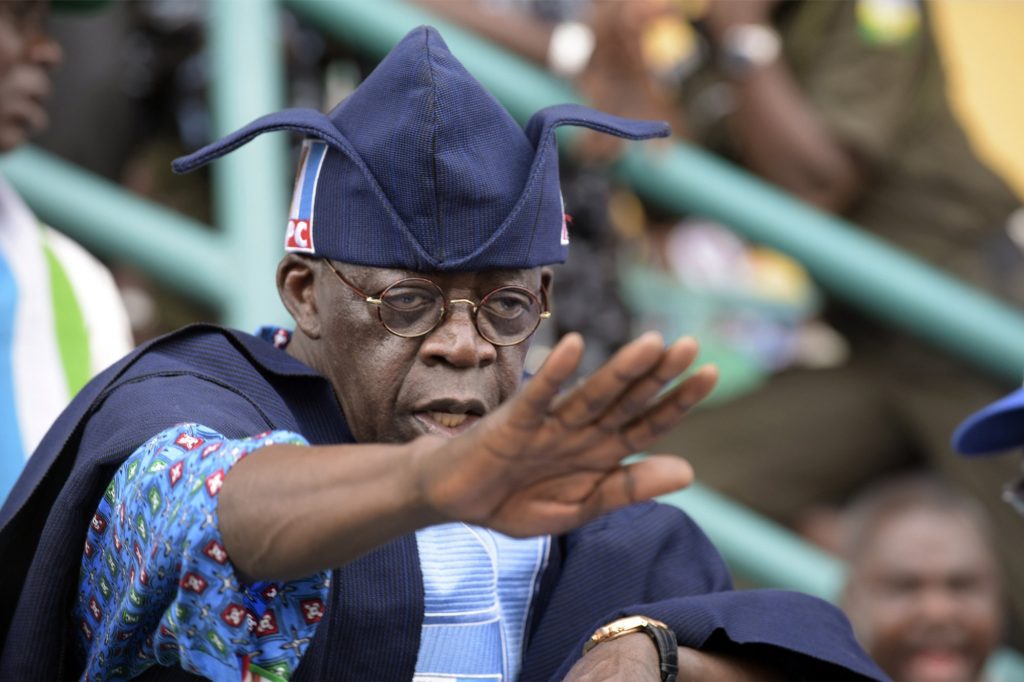
Although the 2023 presidential election is still about three years away, discussions about who will succeed President Muhammadu Buhari have already begun within Nigeria’s political circles.
One of the names increasingly mentioned is that of former Lagos State governor and National Leader of the All Progressives Congress, Bola Ahmed Tinubu.
Tinubu remains one of the most powerful politicians in Nigeria. His supporters point to his eight years as governor of Lagos State, his political organisation and the important role he played in the formation of the APC and the emergence of Muhammadu Buhari as president in 2015.
There are also those who believe Tinubu may eventually seek the presidency when Buhari completes his second term in 2023.
But before Nigerians begin discussing whether Tinubu should become president, there are several controversies surrounding his political career, finances, educational history and extraordinary influence over Lagos politics that deserve serious examination.
The U.S. Drug-Related Forfeiture
One of the most controversial episodes in Tinubu’s past concerns a case in the United States dating back to the early 1990s.
Court documents from the United States District Court for the Northern District of Illinois show that money in accounts connected to Tinubu became the subject of civil forfeiture proceedings in 1993.
Under the settlement reached in the case, $460,000 held in one of the accounts was forfeited to the United States government.
The case involved allegations concerning proceeds linked to narcotics trafficking and financial transactions.
However, an important distinction must be made.
The available documents do not establish that Tinubu was criminally convicted of drug trafficking in the United States.
The proceedings concerned the forfeiture of money rather than a criminal judgment convicting Tinubu personally of trafficking narcotics.
Nevertheless, the absence of a criminal conviction does not mean Nigerians should simply ignore questions surrounding such an episode.
Tinubu is one of the most powerful political figures in the country and is frequently mentioned as a possible future presidential candidate.
If he eventually seeks Nigeria’s highest political office, Nigerians will be entitled to demand a clear explanation about the circumstances that resulted in such a substantial amount of money being forfeited to the American government.
The office of president carries enormous responsibility over Nigeria’s security agencies, anti-corruption institutions and financial system.
Anyone aspiring to occupy that office should therefore be prepared for intense scrutiny of his financial and personal history.
Questions Over His Educational Background
Tinubu’s educational history has also generated controversy over the years.
He has stated that he attended Chicago State University in the United States, where he obtained a degree in Business Administration.
Records associated with Chicago State University have supported his claim that he attended and graduated from the institution.
However, questions have repeatedly been raised about information concerning schools Tinubu claimed to have attended before Chicago State University and some of the educational details contained in documents associated with his earlier political career.
The controversy became particularly significant when questions were raised about information submitted during his time in Lagos politics.
For somebody who may eventually seek the presidency, Nigerians should not have to struggle to understand something as straightforward as his educational history.
A person aspiring to become president should be able to provide a clear and verifiable account of his academic background without conflicting information or prolonged political controversy.
What Is the Source of Tinubu’s Wealth?
Another issue that has followed Tinubu for years is the source and extent of his wealth.
There is little doubt that Tinubu is an extremely wealthy man.
He has been associated, directly or indirectly, with interests across several sectors, including real estate and media.
His political opponents have repeatedly questioned how he accumulated his wealth and whether his financial interests are connected to the enormous political influence he exercises in Lagos.
Tinubu and his supporters have maintained that he was successful in the private sector before entering politics and earned money legitimately through professional work and investments.
But questions surrounding his wealth have refused to disappear.
For someone who has occupied public office and continues to wield considerable influence over government, transparency about personal wealth is important.
If Tinubu eventually decides to contest for president, Nigerians would reasonably want to know the extent of his business interests and whether any of those interests could create conflicts between private financial considerations and public responsibility.
The Bullion Vans at Bourdillon
The controversy surrounding Tinubu’s wealth became even greater during the 2019 general election.
Shortly before Nigerians went to the polls, bullion vans were photographed entering Tinubu’s residence on Bourdillon Road in Ikoyi, Lagos.
The images immediately generated widespread discussion.
Many Nigerians questioned why bullion vans carrying what appeared to be large amounts of money were entering the private home of a powerful politician just before an election.
When journalists questioned Tinubu about the incident, he maintained that he was not a government official and had the right to keep his money wherever he wished.
He also said the money did not belong to the government.
The presence of bullion vans at his residence did not by itself prove that any crime had been committed.
But the incident raised legitimate questions.
Why were bullion vans entering the residence of one of Nigeria’s most powerful politicians immediately before a national election?
Whose money was being transported?
What was the money intended for?
For many Nigerians, Tinubu’s explanation did little to end the controversy.
If a politician is considering becoming president, questions surrounding such an extraordinary incident should not simply be dismissed as opposition propaganda.
The Political Empire in Lagos
Tinubu served as governor of Lagos State from 1999 to 2007.
More than a decade after leaving office, however, his political influence over the state remains enormous.
Successive governors of Lagos have emerged from political structures closely associated with him.
Many lawmakers, party officials, local government politicians and other political figures in the state have also risen through a political organisation in which Tinubu remains the dominant figure.
His supporters regard this influence as evidence of his political brilliance.
They describe him as a strategist capable of discovering talented people, building political organisations and winning elections.
His critics describe the same system as godfatherism.
The concern is whether such enormous political influence concentrated around one individual is healthy for democracy.
Nigeria needs strong institutions rather than political structures that depend heavily on one powerful individual.
If Tinubu eventually seeks to become president, Nigerians will have to examine whether the political system he has built in Lagos represents the kind of democracy they want replicated at the federal level.
The Ambode Episode
The political influence Tinubu exercises in Lagos became particularly clear during the events leading to the 2019 governorship election.
Akinwunmi Ambode became governor of Lagos State in 2015 after emerging from the political establishment associated with Tinubu.
But when Ambode sought a second term, he lost the APC governorship primary to Babajide Sanwo-Olu after influential elements within the party turned against him.
Sanwo-Olu subsequently became governor.
The episode demonstrated the extraordinary power of the political structure surrounding Tinubu.
Supporters argued that party members simply exercised their democratic right to choose another candidate.
Critics, however, saw the episode as evidence that a Lagos governor could struggle politically once he lost the support of Tinubu and his political organisation.
That raises an important question about the nature of political power.
Should democratic institutions be stronger than individuals, or should the political future of elected officials depend heavily on the approval of influential party leaders?
Tinubu and Buhari’s Government
Tinubu was instrumental in creating the political coalition that eventually became the All Progressives Congress.
He also played an important role in the political movement that helped Muhammadu Buhari defeat then-President Goodluck Jonathan in 2015.
Buhari’s victory represented the first time an opposition candidate defeated a sitting Nigerian president through the ballot box.
Tinubu was therefore understandably celebrated as one of the major political strategists behind that historic development.
But political influence also comes with political responsibility.
Five years after the APC took power, Nigeria continues to face enormous challenges.
Insecurity remains a serious problem.
Boko Haram continues to operate in parts of the North-East.
Banditry and kidnapping have become serious threats in several communities.
Unemployment remains high, particularly among young Nigerians.
Nigeria’s electricity supply remains unreliable despite repeated promises of improvement.
The economy has also struggled, while millions of Nigerians continue to live in poverty.
Tinubu cannot reasonably take credit for helping to create the political movement that brought the APC to power while completely distancing himself from the government’s performance.
If he eventually asks Nigerians to support him for president, he may also have to explain what he believes the APC government has done wrong and what he would do differently.
From Kingmaker to President?
For years, Tinubu has been described as one of Nigeria’s most successful political kingmakers.
His influence helped shape Lagos politics.
He contributed significantly to opposition politics nationally.
He was instrumental in the coalition that produced the APC.
He also played an important role in Buhari’s emergence as president.
But being successful at producing candidates is different from being qualified to govern an entire country.
Nigeria is far more complicated than Lagos.
It is a federation of hundreds of ethnic groups and more than 200 million people, with enormous religious, regional, economic and security challenges.
Political strategy may help someone win an election, but governing successfully requires much more.
If Tinubu’s supporters eventually put him forward as a presidential candidate, Nigerians will need to determine whether his political record demonstrates commitment to strong institutions or simply an extraordinary ability to accumulate and maintain political power.
His Record as Lagos Governor
Tinubu’s supporters frequently point to his time as Lagos governor as one of the strongest arguments in his favour.
He governed Lagos between 1999 and 2007 and introduced a number of reforms.
His administration worked to improve internally generated revenue and introduced changes in several areas of government.
Supporters also argue that many of the developments Lagos has experienced since 1999 originated from policies introduced during his administration.
These achievements deserve recognition.
But his record should also be subjected to scrutiny.
Questions concerning transparency, government contracts, political patronage and the close relationship between political and business interests have remained part of the debate surrounding governance in Lagos.
A fair assessment of Tinubu’s record cannot focus only on accomplishments while refusing to examine controversies.
Experience Is Not Enough
There is no question that Tinubu is politically experienced.
Few politicians in Nigeria possess his combination of executive experience, political organisation, financial resources and influence.
He has survived several political battles and has played important roles in some of Nigeria’s biggest political realignments since the return of democracy in 1999.
But political experience alone should not automatically qualify anyone for the presidency.
Nigeria has never lacked experienced politicians.
What the country desperately needs are transparent institutions, accountability, respect for democratic processes and leaders capable of placing national interests above personal political structures.
If Tinubu eventually seeks the presidency in 2023, Nigerians should evaluate not simply whether he understands politics but what kind of political system he represents.
Nigerians Deserve Answers Before 2023
The 2023 presidential election may still appear distant in 2020, but political calculations surrounding Buhari’s succession have already begun.
Tinubu’s name will almost certainly continue to feature prominently in those discussions because of his enormous influence within the APC.
But any presidential ambition should come with serious scrutiny.
The American civil forfeiture case deserves explanation.
Questions surrounding aspects of his educational history deserve clarification.
The source and extent of his wealth deserve transparency.
The bullion vans seen entering his residence before the 2019 election deserve convincing answers.
His extraordinary political control in Lagos deserves examination.
His relationship with the Buhari administration deserves scrutiny.
None of these issues should be exaggerated beyond the available evidence.
It would be incorrect to describe Tinubu as a convicted drug trafficker when the available records do not establish such a conviction.
It would equally be wrong to dismiss every controversy surrounding him simply because his political opponents have used those controversies against him.
The standard should be evidence, transparency and accountability.
If Bola Ahmed Tinubu eventually decides that he wants to move from political kingmaker to president of Nigeria, Nigerians will have every right to examine his past thoroughly.
The presidency is too important for unanswered questions to be ignored.
And long before 2023 arrives, anyone who hopes to succeed Muhammadu Buhari should be prepared to tell Nigerians clearly who he is, how he accumulated his wealth, what he stands for and why he should be trusted with the enormous powers of the Nigerian presidency.